You've had the site survey. You've seen the projected savings. You've agreed, in principle, that installing a commercial solar array, a heat pump, or a battery storage system is the right move for your business.
The technology makes sense, and the installer is ready to go.
But what happens next?
In my experience at Locataire Capital, this is exactly where many energy efficiency projects stall. The transition from an installer's quotation to a fully funded, commercially viable project requires navigating a complex web of tax rules, government schemes, and funding mechanisms.
It's rarely as simple as just signing a standard loan agreement. If you're at the stage where a project is agreed in principle, you need to look beyond the headline cost.
You need to understand how the project interacts with your corporate tax position, your business rates, and the specific funding available for green assets.
Here's my checklist of the financial mechanisms you need to consider before you break ground, and why structuring the finance correctly is just as important as choosing the right technology.
1. Capital Allowances: The 100% Tax Relief
The single most powerful financial lever for commercial energy projects in the UK is the Annual Investment Allowance (AIA). Under current rules, the AIA limit is permanently set at £1,000,000 per year.
This allows businesses, whether limited companies, partnerships, or sole traders, to deduct 100% of the qualifying expenditure on plant and machinery from their taxable profits in the year of purchase.
Solar panels, battery storage systems, heat pumps, EV chargers, and all associated installation costs qualify for this relief. If you install a £200,000 solar array, you can deduct that full £200,000 from your taxable profits immediately.
At the current main Corporation Tax rate of 25%, that's a £50,000 cash saving in year one.
Timing is critical here. Because capital allowances apply in the accounting period the asset is brought into use, scheduling your installation just before your financial year-end can bring that tax saving forward by a full twelve months.
It's worth a conversation with your accountant before you confirm the installation date.
A quick note on Full Expensing: while it was introduced for limited companies with no monetary cap, solar panels are generally classed as integral features, which only qualify for a 50% first-year allowance under Full Expensing.
Using your AIA allocation for solar is almost always the more tax-efficient route.
2. The Business Rates Exemption
A common concern I hear from business owners is that improving their property with solar panels will trigger an increase in their rateable value, leading to higher business rates.
Fortunately, the government has addressed this.
There's currently a 10-year business rates exemption on the rateable value uplift attributable to new rooftop solar installations, confirmed until at least 2035. This means you won't be penalised for generating your own clean power.
Over a decade, this can represent tens of thousands of pounds in avoided costs for a large commercial array, and it's a figure that should absolutely be factored into your project economics.
3. The VAT Position for Commercial Buildings
There's been a lot of noise recently about the 0% VAT rate on energy-saving materials, and I want to be straight with you on this one because it's often misrepresented.
The 0% rate applies almost exclusively to residential accommodation and charitable buildings.
For standard commercial premises, the installation of solar panels, heat pumps, and batteries remains standard-rated at 20%. However, if your business is VAT-registered, this is a cash flow consideration rather than a hard cost.
You'll pay the 20% VAT on the installation invoice, but you'll reclaim it as input tax on your next VAT return. The net effect on the project's economics is neutral, provided your funding facility is structured to manage the initial VAT outlay.
This is something we'll look at carefully when we're structuring your facility, because getting the cash flow timing right matters.
4. Government Schemes and Grants
The landscape for direct grant funding has shifted significantly, and I think it's important to be honest about what's actually available rather than what the headlines suggest.
The Industrial Energy Transformation Fund (IETF), which previously supported heavy industry, has now closed.
Salix Finance continues to provide excellent interest-free loans, but these are strictly ring-fenced for the public sector.
The UK Shared Prosperity Fund closed in March 2026, though regional replacements through Local Growth Funds are emerging in some areas, so it's worth checking with your local Growth Hub.
For most SMEs, the most relevant government intervention is the Growth Guarantee Scheme (GGS), specifically the Green pilot variant. The Green GGS targets solar PV, heat pumps, battery storage, wind turbines, and EVs, providing a government guarantee to accredited lenders.
What I'd stress here is that the GGS is a guarantee to the lender, not a grant to the borrower. It makes lenders more comfortable, but it doesn't change their fundamental underwriting criteria.
A traditional lender backed by the GGS will still assess your application based on historic accounts and balance sheet strength.
That's the gap we're here to bridge.
5. Ongoing Revenue: The Smart Export Guarantee (SEG)
If your solar array generates more power than your building consumes, perhaps on weekends or during summer shutdowns, you can sell that surplus back to the grid via the Smart Export Guarantee (SEG).
You'll need an export meter and to register with a licensed SEG supplier. Rates vary between suppliers, typically ranging from 3p to 15p per kWh. The primary goal of commercial solar should always be self-consumption, since you're offsetting grid electricity at 25p or more per kWh, but a well-negotiated SEG tariff provides a useful secondary income stream that improves the overall return on investment.
6. The Workplace Charging Scheme
If EV chargers are part of your project, it's worth knowing that the Workplace Charging Scheme provides a grant of £500 per socket, up to a maximum of 40 sockets.
That's a potential £20,000 in grant funding that can sit alongside your wider energy finance facility. We'll make sure this is factored in when we're looking at the overall project structure.
The Locataire Capital Approach: Structuring the Solution
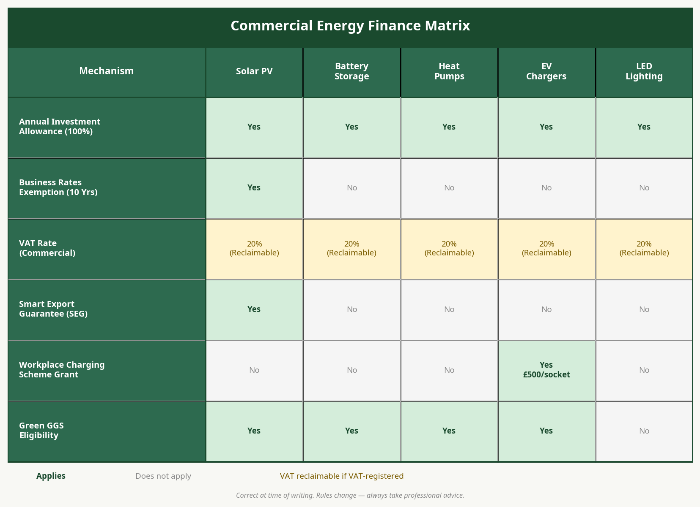
When you look at the full matrix of allowances, exemptions, and guarantees, it becomes clear why a standard high street business loan often falls short for energy efficiency projects.
A traditional lender looks at your historic balance sheet. They see a loan for £200,000 and assess your ability to repay it based on last year's profits. At Locataire Capital, we've built our entire model around the fact that energy efficiency projects are different. They're income-generating, cost-saving assets with measurable returns. We'll look at the installer's quotation, the technology being deployed, and the projected energy savings.
We'll then structure the finance around that savings profile. If the solar array is projected to save your business £4,000 a month in electricity costs, we'll aim to structure a facility where the monthly repayments align with, or are entirely covered by, those savings.
We'll also make sure the facility accommodates the VAT cash flow requirements, and we can wrap multiple technologies, for example solar, batteries, and LED lighting, into a single, manageable agreement.
You don't need a generic business loan. You need an energy finance facility that understands the asset, maximises your tax position, and turns an installer's quote into a cash-positive reality.
The Commercial Energy Finance Matrix
Drop Your Project in With Us
If you've got a quote from your installer and you're trying to work out how to structure the funding, or you just want a second set of eyes on the overall project economics, drop it in with us.
We'll give it a once-over at no cost and no obligation, and we'll tell you honestly what we think the best route looks like.
You can reach us at www.locatairecapital.co.uk.
A Note on Accuracy
The information in this article reflects the rules and schemes in place at the time of writing. Tax legislation, government schemes, and grant availability change regularly, and the specifics of your situation will always affect what applies to you. Please do your own due diligence and take professional advice before making any financial or tax decisions.
The following websites are useful starting points for your own research:
•HM Revenue and Customs (Capital Allowances):www.gov.uk/capital-allowances
•HMRC VAT Notice 708/6 (Energy-Saving Materials):www.gov.uk/guidance/vat-on-energy-saving-materials
•British Business Bank (Growth Guarantee Scheme):www.british-business-bank.co.uk/finance-options/debt-finance/growth-guarantee-scheme
•Ofgem (Smart Export Guarantee):www.ofgem.gov.uk/environmental-and-social-schemes/smart-export-guarantee-seg
•Office for Zero Emission Vehicles (Workplace Charging Scheme):www.gov.uk/government/collections/government-grants-for-low-emission-vehicles
•Find Business Energy Efficiency Grants (Ofgem):www.ofgem.gov.uk/information-consumers/energy-advice-businesses/find-business-energy-efficiency-grants-and-schemes
•Energy Technology List (ETL):www.gov.uk/guidance/energy-technology-list.